
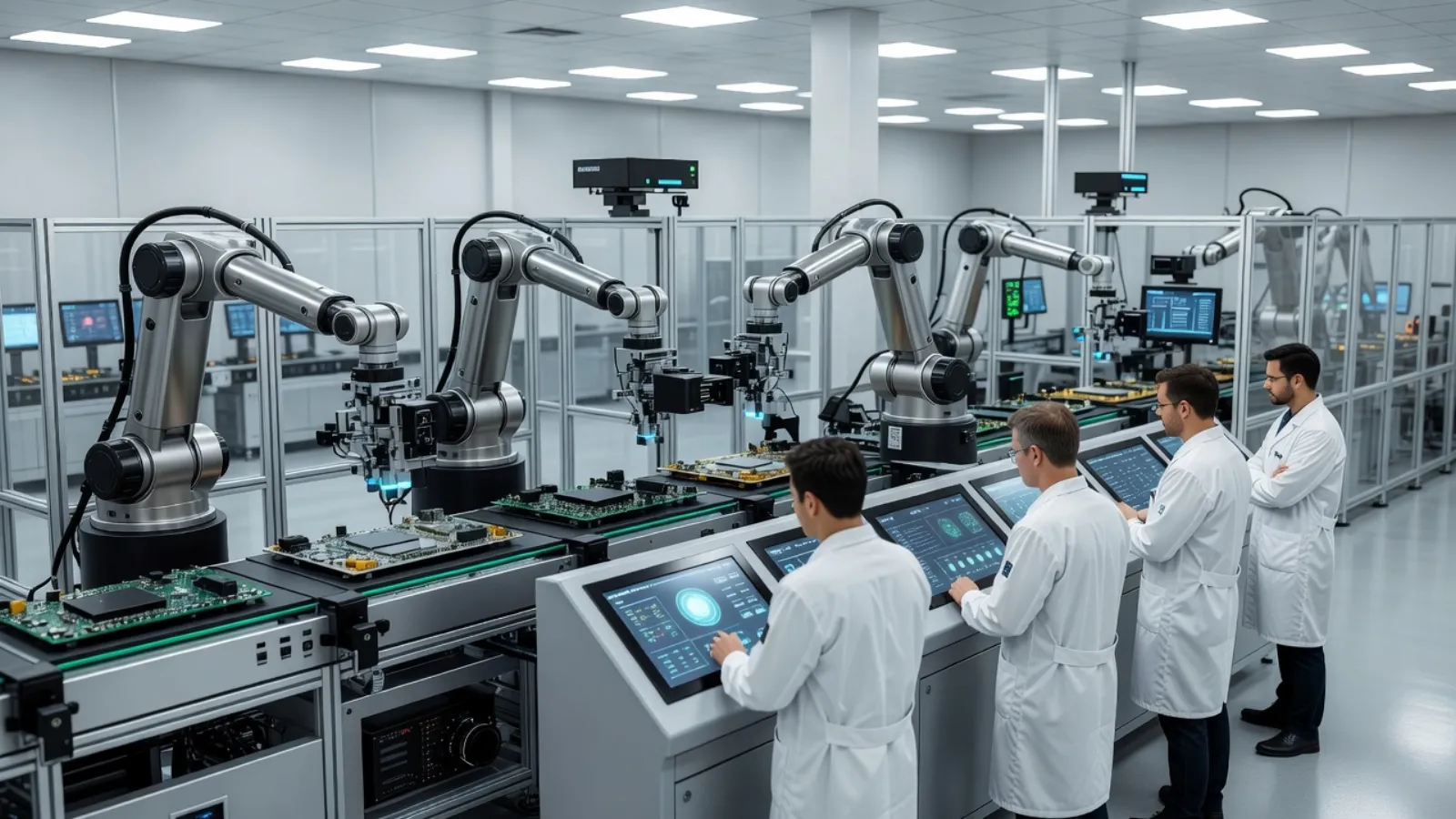
Manufacturing
Scheduling, quality, procurement and maintenance decisions executed by systems instead of spreadsheets.
Manufacturing runs on decisions that repeat every shift: what to build next, what to buy, which deviation matters, which machine needs attention. Most plants still make them in spreadsheets and email, and the cost is not the labor alone. It is the delay between knowing something and acting on it.
We connect ERP, MES, quality and maintenance systems, then put decision automation on top of them. Purchase requisitions raise themselves against real consumption, schedules rebuild when an order or a machine changes, quality records assemble automatically from the data already captured, and the planner spends the day on exceptions rather than on rekeying.
Where the manual work sits today
- Planners rebuilding schedules by hand every time an order, a material or a machine moves
- Purchasing driven by memory and spreadsheets instead of by consumption and lead times
- Quality and traceability documentation assembled manually before every audit or shipment
- Maintenance handled reactively because condition data never reaches a work order
- Plant, quality and cost reporting produced days after the period it describes
Programs we run in manufacturing
Production scheduling and rescheduling
Schedules generated from live orders, materials, capacity and changeover rules, and rebuilt automatically when reality moves.
Purchasing and supplier operations
Requisitions, RFQs, order confirmations and delivery chasing handled by agents against consumption and lead times.
Quality and traceability
Certificates, batch records and non-conformance files assembled from system data, with deviations routed to the right engineer.
Maintenance and reliability
Condition and downtime signals converted into prioritized work orders with parts reserved automatically.
Plant and cost reporting
OEE, yield, scrap and cost reporting produced daily without anyone building a spreadsheet.
What changes for the business
- Schedules that respond in minutes rather than at the next planning meeting
- Purchasing driven by consumption instead of by memory
- Audit and traceability packs available on demand
- Planning and administrative headcount that stops growing with volume
Systems we typically connect
Questions we hear in manufacturing
No, but it sets the sequence. We start with the processes whose data is already reliable, and the first programs usually improve the data itself because entries stop being typed by hand.
No. We read from historians, MES and ERP and write into business systems. Control and safety layers are out of scope by design.
Yes. We normally prove a program in one plant, then roll it out with plant-specific rules held as configuration rather than as new code.
Price it for your operation
Pre-filled with figures typical of this sector. Replace every one of them with yours.
What one manufacturing process costs you
One repetitive process — work orders, purchase orders or quality records — priced end to end.
Labour only. It does not count the rework, the late payments or the customers who left while the queue moved. Runs on 46 working weeks and 1,800 productive hours per person per year. It is an estimate from your own figures, not a quote.
Send these numbers with an assessment requestSee what would come off your desks in manufacturing
Confidential assessment led by senior engineers. No obligation.